With the slogan “Governing from the Board: keys to the different governance models,” the meeting brought together the perspectives of publicly traded companies, family businesses, companies with venture capital shareholders, and third-sector organizations
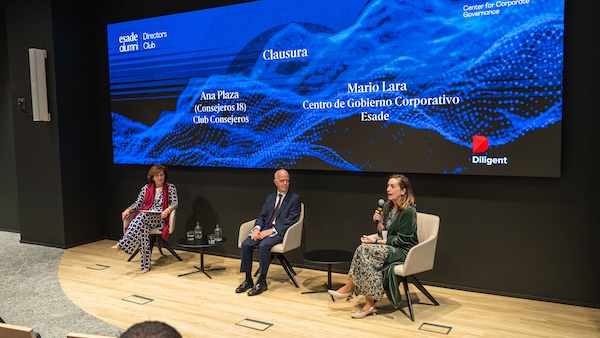
There is no single model of good governance, but there is a shared responsibility: to make better decisions and create value for organizations. The 8th Annual meeting of the Esade Alumni Directors Club revolved around this idea. The meeting was held in Madrid on October 8 and brought together board members, executives, and governance experts to reflect on how governing bodies are changing in view of the challenges of regulation, artificial intelligence, competitiveness, and social impact. It was an exchange of experiences that revealed that boards are facing increasingly similar challenges: spending more time on strategy, adding new capacities, reinforcing the diversity of perspectives, and meeting rising social expectations.
The value of sound judgement
The meeting was opened by Mario Lara, director of the Esade Center for Corporate Governance and of Esade Madrid, and Ana Plaza (Consejeros 18), vice-president of the Board of Directors of the Directors Club. During her talk, Mario Lara highlighted the humanistic nature of Esade and reminded the audience that no code can replace the judgement of those sitting around a board table. The real challenge, she said, is determining whether governing bodies are bringing real value to organizations’ strategic decisions and whether they are paying enough attention to the issues that are able to transform their future.
Ana Plaza, in turn, highlighted the consolidation of the Directors Club as one of the benchmark communities in this field, with more than one thousand members and intense training and mentoring activities geared at developing new board members.
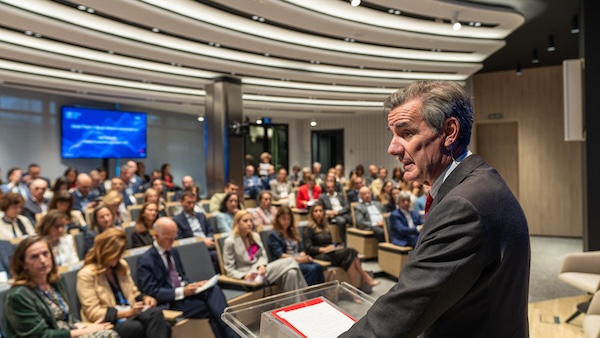
The keynote speech featured Carlos San Basilio, president of the CNMV, who gave a sneak peek at some of the main points in the revision of the Good Governance Code of listed companies, which is expected to be published in 2027.
He explained that the goal is to have a clearer, more direct document focused on recommendations that truly bring value. The revision aims to simplify the content, eliminate aspects that are now contained in laws or are common practices, and reinforce issues related to the independence of board members, the balance of power, and the quality of oversight. Technological transformation also figures prominently in the new revision. Artificial intelligence and digitalization are now an explicit part of boards’ agendas, while sustainability is no longer treated as an emerging issue but is now a cross-cutting dimension of business continuity and competitiveness.
Three business models, three approaches to governance
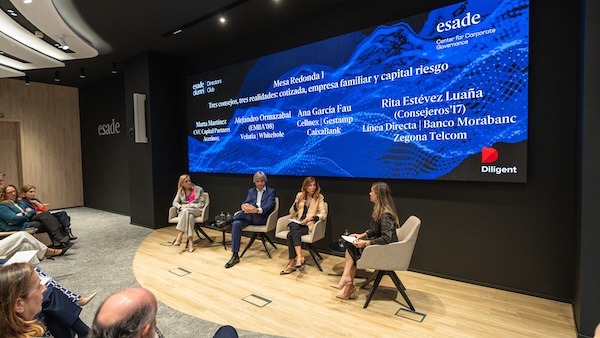
One of the most enriching debates of the meeting contrasted the realities of three very different business models. Moderated by Rita Estévez (Consejeros 17), member of the Board of Directors of the Directors Club, the round table featured Marta Martínez, Industrial Partner at CVC Capital Partners, proprietary director at Tendam and UAX and independent board member at Acerinox; Alejandro Ormazabal (EMBA08), vice-president of Velatia and CEO of Whitehole; and Ana García Fau, independent board member at Cellnex, Gestamp and CaixaBank.
From the standpoint of venture capital, Marta Martínez highlighted the importance of having a detailed plan to create value, as well as close alignment between shareholders and the executive team. Constant monitoring of growth, investments, and results is an essential part of the board's work, although she stressed that trust and commitment to the business project go beyond short-term financial returns.
Alejandro Ormazabal, in turn, upheld the strengths of family companies, characterized by a long-term vision and gradual professionalization processes. The hiring of external talent and the separation between family and business matters are key factors in preserving the identity of the project while also bringing in increasingly sophisticated management.
Regarding listed companies, Ana García Fau outlined a more structured reality marked by specialized committees, risk assessments, succession planning, and constant interaction with markets. However, she warned that increasing regulatory complexity cannot displace the strategic discussions that should characterize an effective board.
The main conclusion of the roundtable was that the best boards do not work as the sum of independent experts but as teams capable of integrating complementary capacities to create collective value.
Purpose
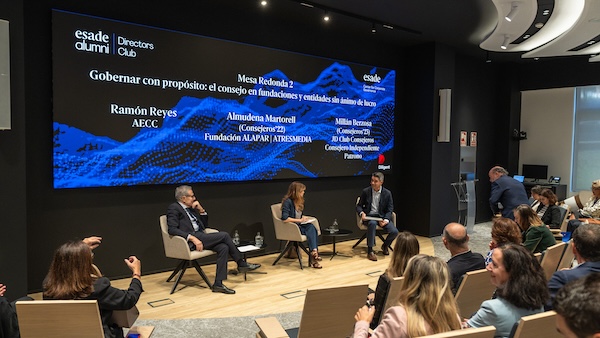
The second roundtable shifted the focus to the third sector and brought together Almudena Martorell (Consejeros 22), president of the Fundación A LA PAR and independent board member at ATRESMEDIA, and Ramón Reyes, president of the Asociación Española Contra el Cáncer (AECC). It was moderated by Millán Berzosa (Consejeros 23), member of the Board of Directors of the Directors Club.
The conversation focused on the importance of turning an organization's mission into an effective guide for decision-making. The speakers concurred that social organizations are facing increasing demands to further their professionalization, economic sustainability, and impact measurement, very similar to the pressures that companies are experiencing.
Almudena Martorell highlighted the particularity stemming from unpaid board membership, a circumstance that influences boards’ composition and operations and opens up new debates about professionalization and dedication. Ramón Reyes, in turn, explained the challenges of governing a complex and highly decentralized organization like the AECC, with its extensive geographical structure and activities that encompass everything from assisting patients to scientific research.
The discussion also addressed the limitations of measuring purpose using only quantitative indicators. The impact in areas like social inclusion, awareness, or improving quality of life often transcends economic results or traditional metrics.
Technology, talent and trust
The meeting concluded with a conversation between Mario Lara and Helena Herrero, independent board member at Naturgy and Mutua Madrileña, who pointed to some of the priorities that will mark the trend on boards in the upcoming years.
Artificial intelligence figured prominently in the reflection. In the opinion of Helena Herrero, the issue is not whether technology will replace board members but how it will allow them to make better decisions. In this scenario, judgment, responsibility, and a critical capacity will continue to be irreplaceable.
She also underscored the increasing importance of aspects like corporate culture, talent management, leadership, and succession processes. In her opinion, people continue to be the main unique feature of organizations and therefore should occupy a central place on boards’ agendas.
She also highlighted the role of companies as social actors in an environment characterized by polarization and uncertainty, as well as the need for governing bodies to foster relations based on trust, listening, and transparency
Throughout the meeting, the same idea was repeated from many different perspectives: good governance can no longer be viewed solely as oversight and regulatory compliance. Boards are also called to play a decisive role in defining strategy, innovation, talent management, and the creation of sustainable value.
The 8th Annual Meeting of the Directors Club confirmed that there is no single universal recipe for governing well. However, there are shared principles: independence, professionalization, long-term vision, capacity to adapt, and commitment to each organization’s mission.
This article was written based on the notes and conclusions collected by Millán Berzosa (Consejeros 23), a member of the Board of Directors of the Directors Club, during the event.