Alejandro Giacomelli is the founder of Rituale, a startup that was launched with the ambition of taking specialty coffee to a new level of experience and sustainability.
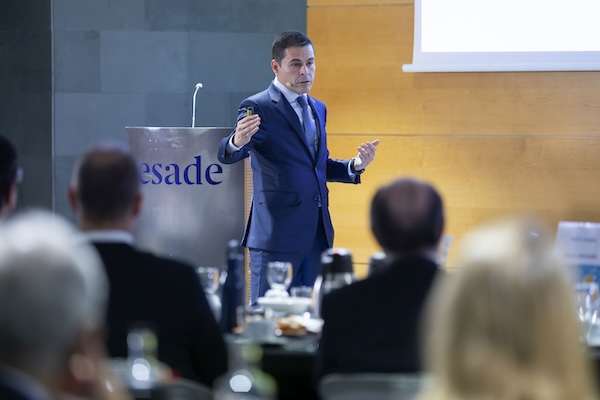
Alejandro Giacomelli founded Rituale with a clear purpose in mind: to redefine experience and sustainability in the world of specialty coffee. However, he is keenly aware that launching a company is not a solitary venture. Thanks to the impetus of the Esade Alumni network – from the Guidance and Mentoring sessions to his recent pitch at Startup Day in Madrid – Alexjandro has turned community support into an engine of growth. We talk with him about his startup’s future and the value of enlisting a solid ecosystem during the seed phase.
-How did you get the idea of creating Rituale, and what opportunities did you detect in the current coffee market?
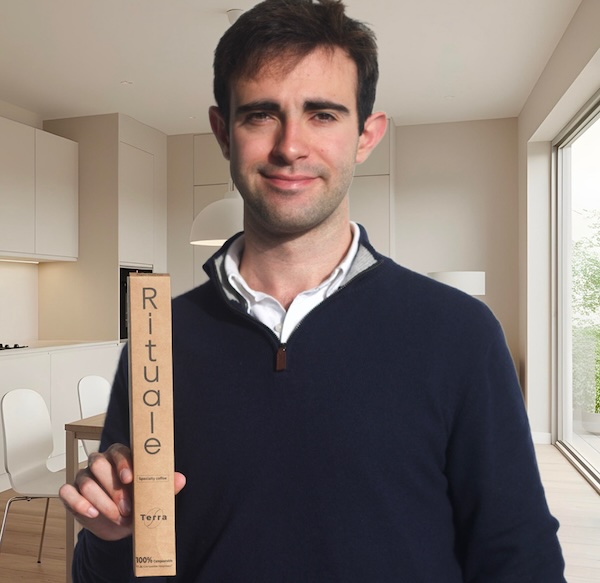
The idea sprang from a contradiction that was hard for me to ignore: millions of homes have a Nespresso machine and aren’t going to change that, but the coffee they consume doesn’t meet the standards of either the machine or the times. The capsule market in Spain moves more than 67 million cups per day, and the vast majority of these capsules combine two problems that nobody had solved at the same time: low-quality commercial coffee and the aluminum cover, 80% of which ends up in the landfill. The opportunity was clear: to make a real specialty coffee capsule without aluminum that could be composted at home and is compatible with the machines consumers already have, without asking them to change anything.
- The brand name suggests an experience that goes further. What defines the “ritual” in your proposition?
Coffee is one of the few moments in the day that people set aside for themselves. It doesn’t matter if it’s first thing in the morning before the day begins or mid-afternoon when you need to take a break, or after lunch to extend a conversation that’s worth continuing. They are repeated, almost automatic gestures but with real emotional import.
Rituale sprang from the conviction that those moments deserve to be on par with all the other decisions we make with discernment: what we eat, what we wear, what we listen to. The ritual is not the coffee per se but the entire deal: the verifiable quality of the product, the packaging design, the fact that the capsule goes back into the earth when you’re done. Everything adds to or takes away from the moment. We want Rituale to add.
- You went through the Esade Alumni Guidance and Mentoring service. What point in the project were you at, and what was the most valuable insight you got?
I came to the Guidance and Mentoring service at a time when the project existed on paper but no irreversible decisions had been made yet. I clearly saw the problem I wanted to solve and had thought of the project, but I wasn’t sure how to begin to build the real company: what to validate first, how to organize the business model, when to launch.
The most valuable insight I got was fairly simple but very difficult to digest when you’re on the inside: not to over-optimize what does not yet exist. There is a natural tendency in professionals with analytical training to want to have all the answers before taking the first step. The mentoring helped me understand that the only validation that matters comes from the market, and that this validation only comes when you have something real in the hands of a real person willing to pay for it.
This pushed me to shorten times, simplify the first version of the product, and launch before I felt comfortable. And it was the right decision.
- How do you think that being part of the Alumni network has accelerated your startup’s growth or your own development?
The Alumni network has value that isn’t obvious until you need it. It’s not only access to contacts but access to people who have gone through something similar to what you’re going through and understand the language without the need to explain everything from scratch.
In my case, what most accelerated my development was not the big doors that opened but the small conversations with people who have spent the last ten or fifteen years building companies and can tell you in twenty minutes what it would have taken you months to discover on your own. This type of access is very difficult to find outside a network like this one.
There is also something more subtle that has to do with setting high standards for yourself. When you surround yourself with people from Esade who have built important things, it raises the bar of what you consider sufficient. That’s uncomfortable, but it’s exactly the type of discomfort that makes you grow more quickly.
Rituale is still in the early phase, so it would be an overstatement to say that the network has played a key role in terms of business. But it has definitely played a key role in terms of mindset, and in this phase that’s equally or even more valuable than any commercial contact.
“The most valuable insight I got was fairly simple but very difficult to internalize when you’re on the inside: not to over-optimize what does not yet exist"
- After participating in Startup Day in Madrid, tell us about the experience of presenting your project to the community of entrepreneurs and investors.
It was amazing. There’s no better way to present a project than to a room filled with investors and people with experience. The questions and conversations that come up later in the networking are extremely enriching and suggest angles that you hadn’t even considered. I especially think that seeing the experience of successful entrepreneurs is essential to find your way and try to minimize the number of mistakes you may make in the process.
- The coffee sector is in the midst of a transformation towards specialty and traceability. How does Rituale Coffee fit into this new paradigm?
Specialty coffee has been gaining ground for years, but there was a segment that had been left behind: the consumer who has a Nespresso machine at home and is not willing to change systems. That’s exactly where Rituale fits. Terra scored above 84/100 in the SCA scale with its blend of Brazilian and Ethiopian coffee with notes of cocoa, walnut, and cherry, and a new certified capsule, TÜV Austria OK COMPOST HOME, is on the way. Real specialty, traceability at origin, and an aluminum-free container that closes the circle: it’s not a niche product for purists but an accessible specialty for anyone who already has the infrastructure in their kitchen.
- Where would you like to see Rituale Coffee within five years? Are there any international expansion plans or new products on the horizon?
In five years I’d like everyone who has a Nespresso machine at home and cares about what they consume to think about Rituale without hesitation. That’s the customer we’re interested in: not the one looking for the cheapest capsule but the one who makes decisions with discernment in other areas of their life and wants their coffee to be on par with them.
In Spain, we’re beginning to have more gourmet shops, hotels that think about every single detail in the room, and catering services that share our philosophy. They’re spaces where the coffee says something about the person or organization serving it. We’re really interested in that.
Likewise, Portugal, France, Italy, and Germany are natural markets for what we do. The volume of Nespresso users is huge, and the sensibility about verifiable sustainability is increasing every year. It’s a window of opportunity that we want to seize before the market fills up.
Regarding the product, Terra is the first one. More coffees are on their way, each with a different origin and their own sensory profile. The idea is to build a family of blends that have the same brand coherence but give consumers real choices depending on the occasion and their palate.
- What would you say to someone in the Alumni community who is considering launching their own business? Do you think you might be a mentor in the future?
The first thing I would say is to begin before you’re ready, because the perfect version of the project won’t come until you actually begin to sell it. Esade provides you with really solid analytical tools, but the market teaches you things that no case study can anticipate. The Alumni network is an underused asset: there are people with experience in exactly the problem you’re solving, and the majority of them are willing to help. Regarding whether I would be a mentor: most definitely. I think that one of the obligations of someone who receives support in the early phases is paying it back when you have something real to offer. I’m still building this company, but that’s the direction I’m headed.