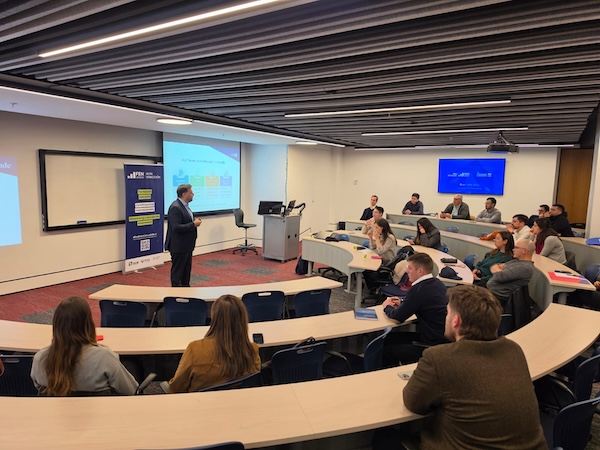
The evening’s featured speaker was the prestigious British journalist and writer John Carlin, who offered an in-depth analysis of international policy in a talk entitled “Conversations with John Carlin in a Troubled World”
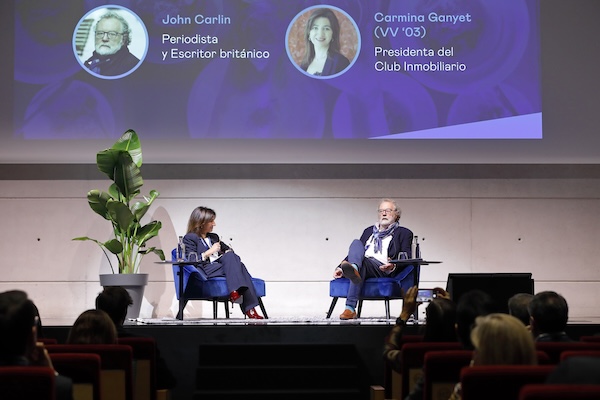
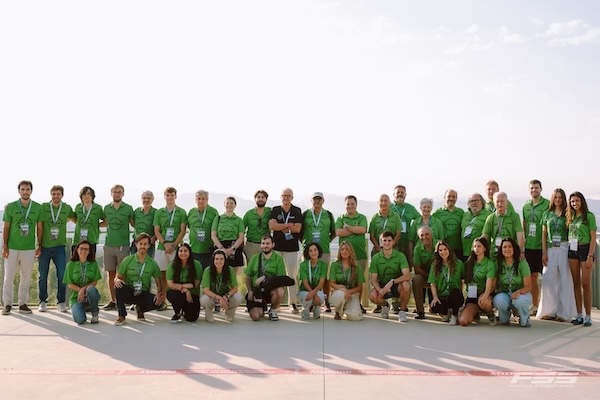
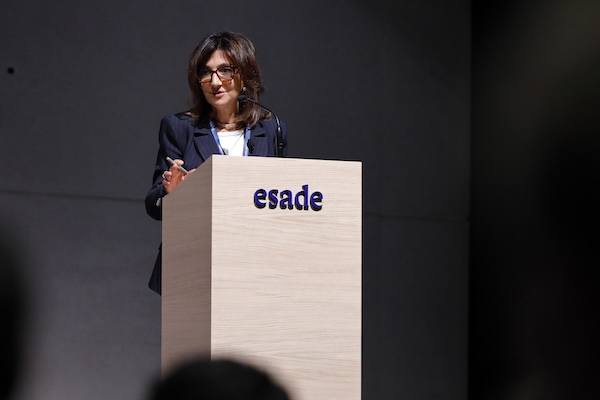
The Esade Alumni Real Estate Club held the 24th edition of its traditional Annual Dinner, an event that brought together prominent professionals from the sector to share experiences and debate today’s global challenges. The event was introduced by Carmina Ganyet (VV ‘03), president of the Esade Alumni Real Estate Club, who welcomed participants before yielding the floor to Carlin.
Leadership in a polarized world
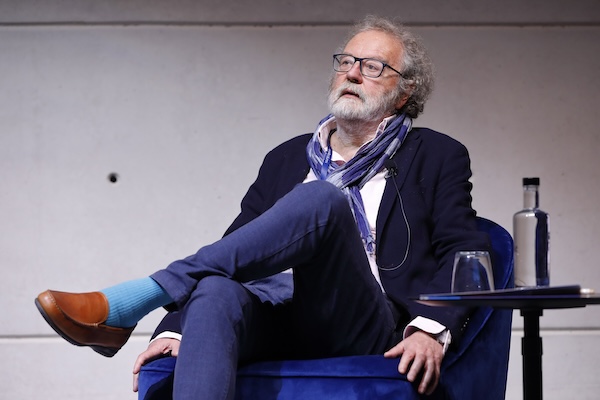
During his talk, John Carlin – the author of The Human Factor, which inspired the film Invictus – focused on the importance of collective leadership and the urgent need to restore trust in institutions. Using his own experiences, especially when he covered the end of apartheid in South Africa, Carlin created a powerful contrast between the leadership styles of Mandela and Trump. “It’s hard to find two more opposite personalities than Mandela and Donald Trump. Mandela built bridges, convinced his enemies, and won them over. Trump confronts and divides,” he said to summarize the dilemma in today’s politics.
The journalist discussed Nelson Mandela’s in-depth preparation during his 27 years in prison: learning the oppressor’s language and studying history to get to know his enemy, all with the goal of negotiating freedom and redemption.. Carlin recalled Mandela’s first press conference after he was released, in which the South African leader articulated his plan: “We have to reconcile while fears with black aspirations,” and he bemoaned the fact that modern politics lacks figures the stature of Mandela, alleging that polarization has become a profitable tool for many politicians.
Democracy, networks, and prosperity
The writer addressed the new social dynamics and the impact of technologies on public discourse, and he was particularly critical of the social media. Carlin claims that these platforms “create tribes, and more noise than light,” and have had “a disastrous effect on public discourse”: they have banalized issues and diluted the concept of truth.
He warned about the global battle being waged between authoritarianism and democracy and urged the audience to value the legacy of freedom of expression and the rule of law: “Our ancestors sacrificed a great deal for what we take for granted: freedom of expression, the rule of law, and now they are being diluted… If the reign of power wins out over the rule of law, more suffering will come and the mistakes of the past will be repeated. We cannot take democracy for granted; we have to consciously defend it.”
Carlin concluded his international analysis with a note of optimism regarding the local situation: “If we look at the world as it is today, we in Western Europe are better off than anywhere else in the world. Let’s value what we have. There is a clear connection between democracy and prosperity.”
You can see the complete video of the session here
Farewell and new leadership of the Esade Alumni Real Estate Club presidency
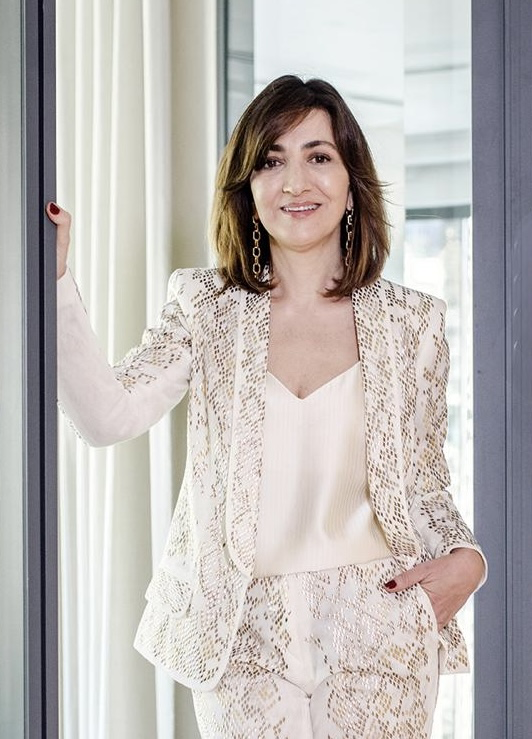
The event concluded with a moving farewell to Carmina Ganyet, who ended her term at the helm of the Esade Alumni Real Estate Club. She thanked her predecessors and the Board of Directors for all the work they have done, and she highlighted the fact that the club has managed to turn its meetings into benchmarks in the sector. Carmina Ganyet then announced the new leadership team, which will be boosted to continue its efforts: José Antonio Alarcón will become the president, with Marta Carrió and Alicia Vicente as the vice-presidents.
We talked with Carmina Ganyet as she ended her term leading the Esade Alumni Real Estate Club.
-During your presidency, what do you think the most successful strategies have been, the ones that have given the club visibility within the alumni community?
 We have been working for years to solidify the club as a key space to connect professionals in the sector, and especially to contribute a rigorous, reflective debate on the challenges we are facing in all dimensions. In this sense, we have made the Residential Meeting [MB1] a venue of debate on housing-related aspects, with contributions and best practices on public-private partnerships and constructive proposals to deal with the emergency regarding the solutions needed on housing matters. We have also consolidated the “Capital Market Investor Sentiment” event, in which we present the trends in the investment community in a highly capital-intensive sector, and where the leading stakeholders share investment priorities annually.
During the year, we have added training sessions with important stakeholders on timely issues (data centers, co-living, etc.), and we periodically and transversally debate and update everything related to ESG in our sector by listening to experts on the adaptation of environmental and social measures and European proposals. Finally, we have also partnered with Esade BAN to launch annual innovation challenges related to the real estate sector.
But one of the things I’m the proudest of is connecting Esade and students with the real estate sector. We’ve managed to get the Real Estate Young Club for current students to actively participate in our sessions and get in direct contact with its professionals and leaders. Plus, thanks to the dedication of professor Jordi Fabregat (our academic leader who participates in all the club’s board meetings), we have managed to create a real estate class that is taught in all degrees and is quite popular among students. These two initiatives, a class that covers all the dimensions of the sector (urban planning, appraisal, markets, innovation, ESG, etc.) and the connection with the Young Club enable us to generate a quarry of future professionals and leaders with the Esade imprint, which guarantees excellence and professionalism in a key sector for our economy and our lives. This leads me to be very optimistic about the future of the real estate sector and of Esade as a benchmark school in this field.
- What are your takeaways, both personal and professional, from the years you’ve devoted to the club?
Personally, I am taking away the satisfaction of having met incredible professionals who have participated and with whom we’ve worked intensely to bring a constructive voice to the sector with excellence and rigor, with the quality of the values that Esade conveys. Professionally, I am taking away the need for cooperation as a lever of growth and consolidation. Close interdisciplinary cooperation among the different clubs and between Esade and the clubs is an essential ingredient in the success of any initiative. The dimension required by the professional debate in any sector, the consolidation of the predecessors’ efforts, and the dimension that Esade deserves as a benchmark in the training of outstanding professionals are achieved just with cooperation, interdisciplinary work, and intergenerational involvement.
We have gone through years with many different cycles and unexpected challenges, and the club has always been anticipating and supporting professionals in the sector. It is a huge satisfaction to have been able to work with the entire Board to contribute to getting through these complex yet exciting cycles that are constantly challenging us.
- What characteristics do you think are indispensable for the sector’s future leaders?
Just like any other sector, knowledge of all the aspects of geopolitics today is essential in any leader’s decision-making. Geopolitics means understanding both the risks and the opportunities, and understanding how it may affect economies and their growth and therefore possible monetary policy measures. Real estate is a very capital-intensive sector, so changes in interest rates, inflationary pressures, and tension in the costs of energy and raw materials are all crucial in our sector. Anticipating the risks makes it possible to manage the cycles, but it also allows you to intuit opportunities. Being aware of the demographic and sociological trends and the country’s innovation, science, and energy strategies are also key factors for any leader in the sector to understand how real estate investment related to key infrastructures works as the lever of transformation of the economies and cities of the future.
- What do you think are the challenges or unfinished business that the club’s new leader has to address?
Our board’s main challenge is precisely to train and shine a light on the key factors that are going to design the future of the sector. Europe’s strategic commitment enables us to reflect on the real estate investments that should support the European challenge. And in this sense, our economy, which is better in relative terms than the rest of Europe, should enable us to attract the investment needed to spearhead this challenge. The new board and the sector in general can play an important role in this debate and in the opportunity for Spain.
Housing is another fundamental factor that still needs to be addressed constructively yet effectively. The demographic evolution, the need for an inclusive migratory policy, and increasingly severe inequality, along with the scarcity of the supply, pose a huge challenge that is growing bigger by the day. The club will continue to engage in this ongoing dialog with the public administration to establish a stable, secure environment so the sector can respond to and provide solutions to this huge challenge, which has become structural. And to conclude, I encourage the new board to continue working with Esade and the other clubs not only to join efforts but especially to train responsible new professionals who are committed to a sector that is essential in our lives and in the future of our economy.